Home › Kids Room & Toy Organization
How to Start a Toy Rotation in 5 Steps (Less Mess, Happier Kids)
If your living room floor disappears under toys every day, the problem usually isn't a lack of storage — it's that every toy is out at once. A toy rotation keeps a small selection available and stores the rest. Swap the sets every week or two, and old toys feel new again.
Many parents find that with fewer choices, children play longer with each toy, and cleanup takes minutes instead of half an hour.
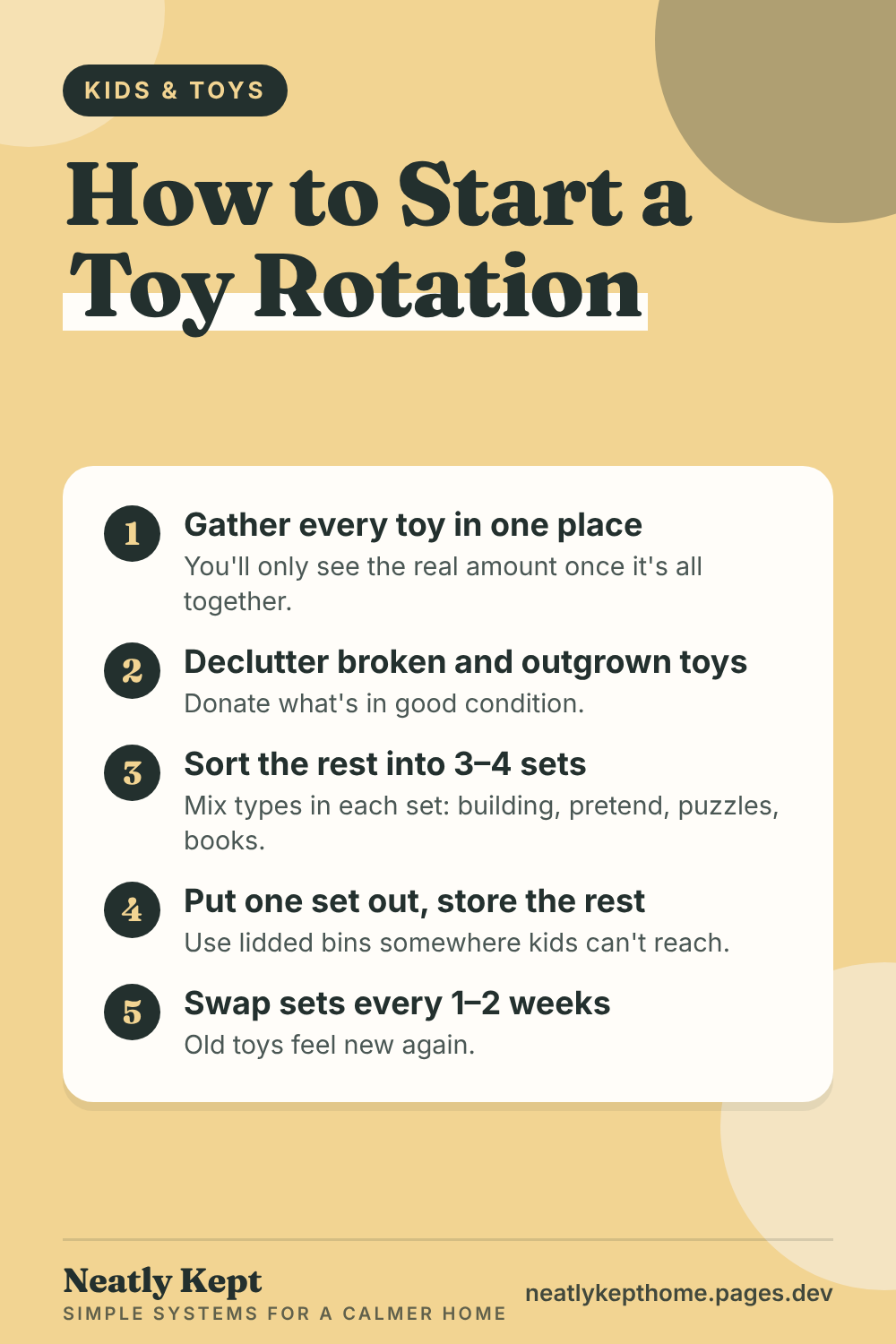
Step 1: Gather every toy in one place
Bring toys from every room into one spot. It's often surprising how many there are — and you can't plan a rotation until you see the full amount.
Step 2: Declutter broken and outgrown toys
Remove:
- Broken toys and puzzles or games with missing pieces
- Toys your child has outgrown — donate or pass them on
- Duplicates — do you need four toy cars that are almost the same?
Involve older children in decisions about their favorites. For younger children, it's often easier to do this step while they're asleep or out.
Step 3: Sort the rest into 3–4 sets
Divide the toys into sets that each include a mix of types:
- Building — blocks, bricks, magnetic tiles
- Pretend play — dolls, kitchen, figures, vehicles
- Thinking — puzzles, shape sorters, games
- Creative — crayons, play dough, craft kits
- Books — a few from each set
Keep a few favorites out all the time: a beloved stuffed animal or a toy they ask for daily shouldn't disappear.
Step 4: Put one set out and store the rest
- Store the other sets in lidded bins, out of sight and reach — a closet shelf, under a bed or in the garage.
- Use open bins or low shelves for the active set so kids can see and reach everything.
- Add picture labels to the bins so children can tidy up without help.
Step 5: Swap sets every 1–2 weeks
Pick a regular day, such as Sunday evening. Pack the current set away and bring out the next one. Watch what gets played with and what doesn't — toys that are ignored for several rotations are good candidates to donate.
Make it work in a small home
- One basket per child for their active set
- A storage ottoman or bench in the living room for quick cleanup
- Under-bed bins for stored sets (see our small-space storage ideas)
Quick cleanup routine
At the end of the day, set a 5-minute timer and play "beat the clock." With fewer toys out, children can often tidy up the whole set themselves. It fits neatly into a family 10-minute evening reset.
Safety reminders
Check toys for loose parts, sharp edges and small pieces that could be a choking hazard for younger siblings, and follow the age guidance on toy packaging. Keep stored bins somewhere stable where they can't fall.